Executive Summary: The Disconnect Between Law and Digital Discourse
On September 3, 2026, the Broward County State Attorney’s Office officially concluded its investigation. The case involved the fatal June 30, 2026, shooting of 62-year-old Army veteran and trauma nurse Bart DiGuglielmo. The incident occurred outside a North Lauderdale Walmart.
State prosecutors ruled that Melissa Payne is legally immune from criminal prosecution. She fired the single fatal shot during a volatile parking space dispute. Her immunity falls under Florida’s Stand Your Ground law.
Following our initial report detailing the Melissa Payne Walmart video and initial case facts, the digital square erupted into permanent polarization. This case offers an explicit look at a distressing contemporary phenomenon. It shows how deeply embedded biases allow digital observers to distort clear-cut video evidence. They manipulate facts to satisfy a preferred cultural narrative.
The Hard Evidence vs. The Immediate Digital Reaction
To understand the massive disconnect online, we must first establish the concrete timeline. This sequence is verified by law enforcement surveillance, surrounding Tesla dashcam infrastructure, and bystander cell phone audio:
- 12:30 p.m. Both drivers simultaneously contest a single parking space outside the Walmart facility. Payne ultimately occupies the spot.
- 12:32 p.m. DiGuglielmo exits his vehicle and enters the store. He returns shortly after, visibly shaking with anger. He aggressively pursues Payne’s vehicle and threatens property damage.
- The Retreat: Over a continuous 90-second window, surveillance footage documents Payne backing away. She repeatedly commands DiGuglielmo to keep his distance.
- The Climax: Audio captures DiGuglielmo taunting Payne. He shouts, “Do it! Shoot!” as he advances directly into her driver-side threshold. He corners her, and Payne fires a single defensive round into his abdomen.
Under Florida Statute § 776.012, individuals have zero duty to retreat in a lawful space. Specifically, they must simply hold a reasonable belief that deadly force prevents imminent death or great harm. Furthermore, Florida law mandates that the state bears the entire legal burden to disprove a self-defense claim. Consequently, the citizen does not have to prove their innocence. Because the state could not legally overcome Payne’s clear evidence of reasonable fear, criminal immunity was mandatory.
Shifting From Law to Social Media Backlash
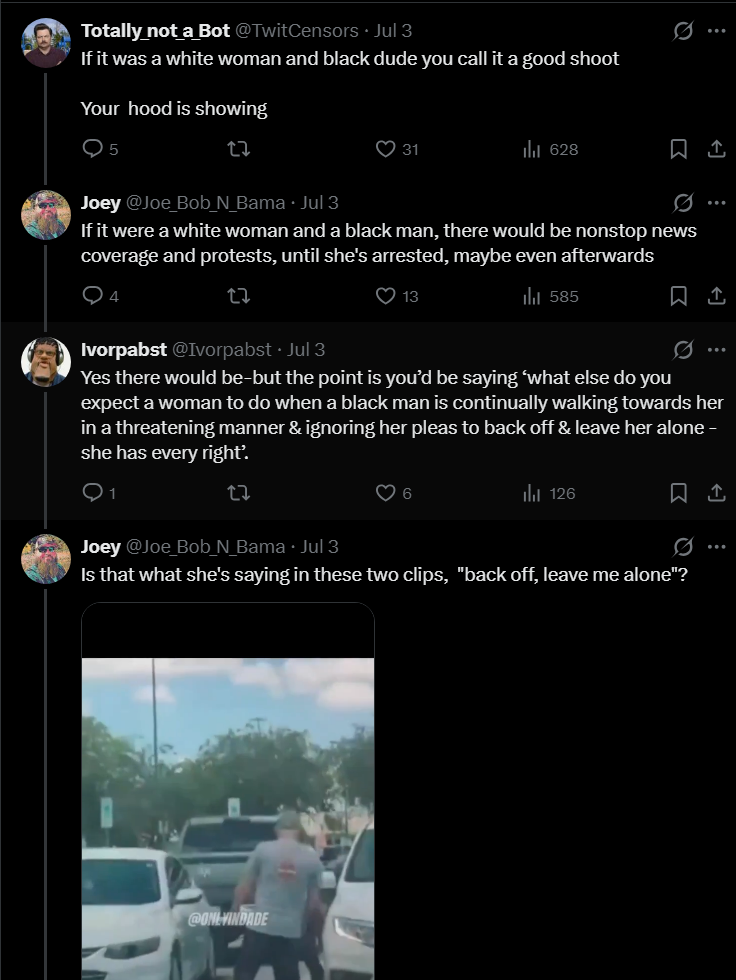
However, public perception immediately fragmented. The first wave of internet discourse focused heavily on trying to decipher the raw legality of the incident. Users instantly launched into highly charged hypothetical debates regarding double standards, race, and the application of the law.
Public Backlash and the Racial Polarization of the Debate
The state’s decision has ignited intense debate across social media platforms. Instead of focusing on the specific statutory text, the immediate reaction online split along deeply entrenched racial divisions. This clash reflects a broader, well-documented criticism of Stand Your Ground laws. Public perception frequently deviates from strict legal reality.
On platforms like X, users immediately bypassed the legal parameters of fear and retreat. They mapped their own racial interpretations onto the footage. This behavior sparked sharp double-standard arguments in the replies.

The Hypothetical Debate Escalates
The pushback against double standards quickly drew direct counterarguments. This shift shows how deeply entrenched these online biases run.
When confronted with the racial reverse-hypothetical, Joey (@Joe_Bob_N_Bama) explicitly rejected the comparison. Rather than looking at the specific actions shown in the video, he shifted the argument entirely. He turned to broad demographic generalizations about violence patterns instead.
This reaction shows a common pattern in online commentary. Individuals frequently abandon neutral legal analysis to protect their preferred cultural narrative.

Post-Hoc Justification and History-Mining
As the digital divide deepened, the conversation shifted away from the video details. People stopped analyzing the physical dynamics of the parking lot confrontation. Instead, online observers began digging for external information to validate their emotional reactions after the fact.
Within days, individuals bypassed the active investigation completely. They searched for old, public court dockets relating to Bart DiGuglielmo’s past.
A desktop screenshot of his 2008 criminal record soon surfaced on the timeline. It became an instant focal point for both sides. Joey quickly responded to the discovery and dismissed the relevance of the decades-old charges.

Unearthing the Public Records
The search for historical context led online sleuths straight to a public record database. This search ended up unearthing the precise legal history of the deceased.
The full desktop record shows a 2008 docket detailing a string of serious offenses. These include charges of Aggravated Stalking, Terroristic Threats, Family Violence Simple Battery, False Imprisonment, and Criminal Damage to Property.
For those analyzing the case online, the appearance of these documents fundamentally shifted the conversation. It gave observers a concrete backstory to project their opposing viewpoints onto.

Personal Ethics and the ‘Psychopath’ Defense
As the thread progressed, the debate moved from analyzing public records to evaluating personal protective instincts. An account challenged Joey by presenting a protective scenario. They argued that most people would react violently if an aggressive stranger approached their spouse over a parking spot.
Joey immediately rejected the comparison. He labeled a lethal reaction as psychopathic. In addition, he claimed his own life experience proved that heated arguments can always be resolved without deadly force.
This interaction perfectly captures a unique psychological dynamic. It shows how people use their personal code of ethics to judge a fluid, high-stress self-defense encounter.

Street-Level Logic vs. Legal Misconceptions
The discussion soon broadened as multiple accounts chimed in with competing shortcuts to judge the conflict. Commenters like Forest Gump and Turtlejesus pinned the blame squarely on DiGuglielmo’s behavior. They used popular phrases like “play stupid games, win stupid prizes” to argue that tracking down an armed individual is inherently reckless.
At the same time, an account named us Wolf Krieger attempted to apply formal legal concepts. They claimed that brandishing a firearm during a dispute automatically constitutes aggravated assault. In their view, this action cancels out any self-defense protections.
This clash highlights a major gap in public understanding. Specifically, people often rely on street survival rules or personal assumptions about weapon deployment. Unfortunately, these ideas directly contradict how Florida’s statutory text actually works in practice.

AI Validation and the Rise of Tribal Framing
As the online debate intensified, observers began leaning on automated technology to validate their perspectives in real time. An account named Angry Black Sheep and White Supremacist pulled a legal summary from Grok directly into the feed. This action tracked down the explicit text of Florida Statutes Chapter 776.
This behavior shows how modern platforms allow individuals to instantly look for authoritative sources to support their initial gut reactions. However, as the legal framework surfaced, the surrounding commentary took a sharp turn into explicit racial framing.
Accounts like JJ from Philly and DjLando bypassed the legal criteria entirely. Instead, they focused heavily on the racial identities of the involved parties to assign blame. This shift demonstrates how quickly an objective legal discussion can degrade into tribal conflict when a tragic event hits social media feeds.

Shifting Focus From Law to Identity
The Collapse into Dehumanization and Slurs
The thin veneer of an objective legal debate completely shatters as threads remain active over multiple days. Some accounts continue to evaluate the situational details. They point out that warnings were issued or that the confrontation was recorded. However, the underlying tribalism rapidly devolves into raw hostility.
This breakdown is starkly illustrated by a commenter named Michael. He abandons the facts of the case entirely to unleash an explicit racial slur. He uses the tragedy to make broad, derogatory generalizations about Black individuals. Furthermore, he openly tells others to arm themselves in response.
This moment in the comment feed exposes the most dangerous layer of digital outrage. A high-profile tragedy quickly ceases to be a discussion about statutory compliance. Instead, it transforms into a toxic space where extreme, unchecked hatred is weaponized out in the open.

Weaponizing Literature in the Digital Arena
As the comment sections fluctuate between vitriol and analysis, some participants attempt to anchor their arguments back into the text of the law. An account named Richard Housden shared the cover of “The Law of Self Defense: The Indispensable Guide for the Armed Citizen.” He used it to provide an authoritative, structural baseline for why the shooting fell under legal protection.
This inclusion immediately sparked a wave of aggressive agreement in the replies. Accounts like NY_Mets_Giants_Knicks and Kuding Cornbread used harsh profanity and blunt street phrasing to drive home a central point. They emphasized that the aggressor was repeatedly told to stay back and chose to advance anyway.
This phase of the interaction shows how digital observers utilize physical media and literature as weapons. They deploy these assets to shut down opposing arguments and reinforce their personal interpretation of reality.

Trivial Catalysts and Absolute Statutes
The conclusion of this initial thread highlights the massive gap between everyday human reasoning and strict statutory law. An account named Willie Davis points out the sheer absurdity of the physical catalyst. He notes that a standard, unshaded parking space is a completely trivial reason to risk a violent confrontation.
While logical observers view the escalation as entirely unnecessary, other commenters like Joe Kerr and TiredOfYourBS pivot back to cold legal realities. They note that regardless of how a dispute begins, the application of Stand Your Ground centers entirely on the final moments of the encounter.
By highlighting that Payne spent 90 seconds backing away before firing, these observers demonstrate an important reality. The statutory text leaves zero room for nuance once a threat becomes imminent.

Anatomy of Bias: The Broader Social Feed
An analysis of the public posting history for Joey’s account (@Joe_Bob_N_Bama) reveals a telling trend. His intense opposition to Melissa Payne’s immunity aligns with a broader pattern of racially charged commentary, gender bias, and explicit prejudice.
This digital footprint demonstrates that online outcries are rarely neutral interpretations of safety or law. Instead, viral tragedies are frequently weaponized by polarized accounts. They map their pre-existing worldviews directly onto active news events.
Explicit Support for Segregation
The account’s historical feed demonstrates overt hostility toward Black individuals. A major media release recently spotlighted a documentary addressing systemic issues in the American South. In the public replies to that release, Joey explicitly posted that segregation is the solution.
He followed up the comment by baselessly claiming that Black individuals control regional prison systems. Furthermore, he argued that mainstream media outlets intentionally censor that narrative.
This baseline perspective heavily colors how he views a self-defense case involving a Black citizen. It shows that his demand for an immediate arrest bypasses the statutory facts entirely. He shifts his stance simply to satisfy an existing ideological bias.

Systemic Arguments and the Defense of Local Institutions
The deep dive into his profile shows that his ideological stance extends into debates over state infrastructure and labor dynamics. When challenged by another account regarding the financial motivations behind regional corrections facilities, Joey shifted his focus to defending state spending.
He argued that inmate labor serves strictly to offset the financial burden on taxpayers rather than generating institutional profit. Furthermore, he attributed new facility funding to long-term public debt.
This prolonged debate highlights a rigid worldview focused heavily on containment and systemic management. The interaction takes a sharp turn when his challenger attempts to break the tension. They posted a photo of interracial couples with a call for more unity. This setup sets a direct baseline for the personal biases that Joey openly expresses elsewhere on his timeline.

Radical Anti-Miscegenation Rhetoric
Any ambiguity regarding Joey’s underlying biases disappears when reviewing his direct posts from the same period. In an immediate departure from neutral civic discourse, his timeline contains explicit anti-miscegenation propaganda targeting interracial families.
The shared graphic openly declares interracial relationships as a crime against one’s people. It utilizes hostile slogans to promote racial exclusion. This overt display of prejudice provides critical context for his reaction to the Walmart shooting.
His demand for the immediate arrest of a Black woman acting in self-defense does not stem from a strict, principled view. Therefore, it does not reflect consistent beliefs about firearm regulations or pretrial detention. Instead, it reflects a broader ideological framework.

The Direct Pushback Against Exclusion
Joey’s explicit posting history drew immediate, public resistance from other observers on the platform. In a direct reply to the segregation rhetoric, Michael Royal posted photos of smiling, interracial couples. He did this to counter the narrative of division.
His comment openly criticized the idea of racial separation. He called it a sad worldview. Furthermore, he stated that the world needs more unity and love.
This exchange reveals a vital layer of online social commentary. It shows that while highly visible accounts use tragedies to spread prejudice, the digital ecosystem still contains active pushback. Everyday individuals frequently step in. They use real-world examples of happiness and integration to dismantle toxic bias.

Ideological Worldviews and Systemic Biases
Hostility Toward Minorities and Women
This pattern of structural prejudice shows up consistently across his timeline during major political events. On August 4, 2026, the Michigan U.S. Senate primary election was underway. A political aggregate account posted updating polling statistics for candidates Abdul El-Sayed and Haley Stevens.
Joey replied to the update by expressing direct disgust at the choices available to voters. He wrote that having a choice between a non-white individual or a woman showed what the country had come to.
This comment reveals that his immediate public hostility is anchored in a deeply rigid worldview. It targets individuals based entirely on identity markers. This behavior proves that his aggressive stance on active news stories is part of a broad, multi-layered framework of exclusion.

Summary of the Backlash
When looking closely at this verified history, the intense anger directed at Melissa Payne does not stem from a neutral stance. It does not reflect a consistent view on pretrial detention, gun safety, or firearm laws. Instead, the connection becomes undeniable.
Calling for the immediate arrest of a Black citizen acting in clear self-defense exposes the true driver of the outrage. This demand is paired with public calls for racial segregation and dismissive remarks about political candidates based entirely on race and gender. Ultimately, these actions highlight how deeply entrenched personal biases continue to polarize public perception of Florida’s legal system.
The Psychological Mechanics of Bias
The human brain excels at using high-profile tragedies as canvases to project its own pre-existing worldviews. In the digital court of public opinion, objective evidence will always be filtered through a person’s tribal identity. This includes details like a 90-second retreat video or an explicit verbal warning. Therefore, if the facts of a case do not align with an observer’s preferred cultural narrative, the digital ecosystem makes distortion easy. Observers can ignore those facts entirely to protect a personal bias.
Conclusion: The Fractured Public Square
Ultimately, while social media spaces remain highly divided over the ethics of the encounter, the Broward County State Attorney’s Office made its determination strictly on the parameters of the written law. When an individual is aggressively cornered and issues repeated warnings, Florida law firmly protects their right to stand their ground.
Tragedies outside a local store will always attract instant attention. However, modern online platforms continuously reward immediate outrage over legal literacy. As long as this dynamic persists, viral news stories will continue to serve as mirrors for our deepest societal fractures rather than opportunities for objective truth.
Leave a Reply